
Gardening Tips
Garden Pests: Organic Control Methods
Oct
Garden Pests: Organic Control Methods
There’s a special kind of heartbreak in walking out to your garden on a Saturday morning and finding your kale shredded into lace, your tomatoes dotted with holes, or your beans crawling with aphids. Before you reach for the chemical spray bottle, take a breath. For home gardeners, harsh pesticides are usually overkill — and they come with real downsides, from harming pollinators to lingering on the food you’ll eat.
Organic pest control isn’t about letting the bugs win. It’s a practical set of methods that work with nature instead of against it, and they’re more than enough for the scale of a home garden. Here’s how to keep pests in check the organic way.
Start With Prevention: Healthy Plants Fight Back
Most experienced organic gardeners will tell you the same thing: the best pest control happens before pests ever show up. A vigorous plant is like a well-fed athlete — it shrugs off minor attacks that would flatten a weak one.
Build your defenses on a few habits:
- Feed the soil, not just the plant. Healthy, biologically active soil grows plants with thicker cell walls and stronger natural defenses. Compost is your best friend here.
- Water right. Overhead watering that leaves foliage wet overnight invites fungal problems and slugs. Water at the base, in the morning.
- Rotate and diversify. Planting the same crop in the same spot year after year lets soil-borne pests build up. Mix things up — diversity confuses pests.
- Clean up spent plants. Fallen fruit and dead foliage are pest nurseries. Tidy beds at the end of the season break pest life cycles.
Know Your Enemy: Scout Before You Treat
Not every insect in the garden is a villain. In fact, roughly 97 out of 100 insect species are beneficial or neutral — pollinators, decomposers, and predators that eat the actual pests. Before treating anything, spend ten minutes a week scouting: flip leaves, check undersides, and look for chewed edges, stippling, or sticky residue.
Learn the usual suspects in your area — aphids, cabbage worms, slugs, squash bugs, and cutworms are common across most of the US. Once you can tell a ladybug larva (your ally) from a Colorado potato beetle larva (your problem), you’ll stop spraying the good guys.
Invite the Predators: Biological Control
One of the most satisfying forms of organic pest control is recruiting an army of helpers who work for free. Many beneficial insects and animals eat common garden pests, and attracting them is easier than you think.
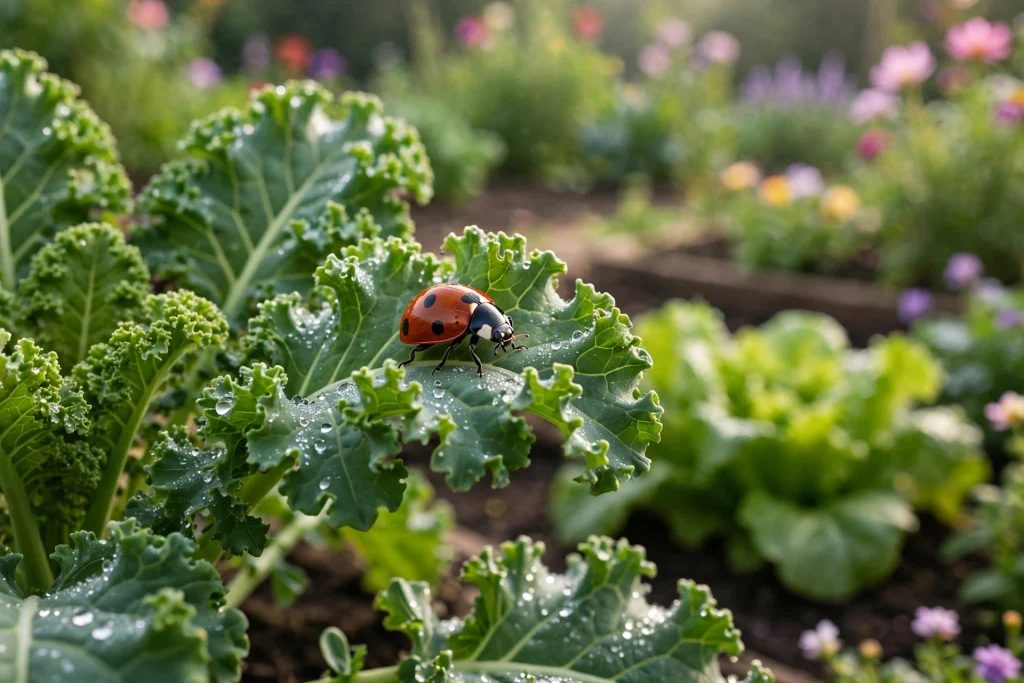
Ladybugs and lacewings devour aphids, mites, and small caterpillars by the hundreds. Parasitic wasps — tiny, stingless, and harmless to people — lay eggs inside aphids and caterpillars, ending the problem from the inside out. Ground beetles and spiders patrol the soil surface for slugs and cutworms at night.
How to attract them? Plant a border of insectary flowers: sweet alyssum, dill, fennel, cosmos, and yarrow are proven magnets for beneficial insects. A small dish of water with pebbles (so they can land and drink) doesn’t hurt either. Skip the broad-spectrum “bug bombs” — they kill the predators faster than the pests, and pest populations rebound first.
Barriers and Traps: Physical Control
Sometimes the simplest answer is a wall between the pest and the plant. Physical barriers are underrated, immediate, and completely chemical-free.
Floating row covers
Lightweight fabric draped over crops lets sun and rain through while blocking flea beetles, cabbage moths, and other flying insects. Put them on right after transplanting, before pests arrive, and secure the edges with soil or rocks so nothing sneaks underneath.
Copper tape and collars
Slugs and snails hate crossing copper — it gives them a mild electric shock. A ring of copper tape around raised beds or pots is remarkably effective. For cutworms, a simple cardboard collar around each seedling stem (buried an inch deep) stops them cold.
Traps
Beer traps (a shallow cup of beer sunk to soil level) lure and drown slugs overnight. Yellow sticky traps catch whiteflies and fungus gnats and double as a monitoring tool — the number of insects stuck tells you whether your problem is growing or shrinking. Hand-picking larger pests like hornworms and Japanese beetles into a bucket of soapy water remains one of the fastest fixes around.
Botanical Sprays: Your Last Resort, Used Wisely
When barriers and predators aren’t enough, organic sprays can tip the balance. The key word is targeted — even organic products can harm beneficial insects if sprayed indiscriminately, so always spot-treat the affected plant rather than blanketing the whole garden.
- Insecticidal soap is excellent against soft-bodied pests like aphids, whiteflies, and spider mites. It works only on contact, so spray directly on the insects and repeat after a few days.
- Neem oil disrupts feeding and reproduction in a wide range of insects. Apply in the evening to avoid harming bees, and never spray open blooms.
- Diatomaceous earth is a fine powder of fossilized algae that shreds soft-bodied insects on contact. Dust it around plant bases in dry weather; it stops working when wet.
- Bacillus thuringiensis (Bt) is a naturally occurring bacterium that targets caterpillars specifically — caterpillars eat it and die, while bees, birds, and people are unaffected. It’s the go-to for cabbage worms and hornworms.
Always read the label, even on organic products, and spray in the evening when pollinators are less active.
The Integrated Approach: Put It All Together
Organic pest control works best as a system, not a single magic product. Think of it in layers: healthy soil and plants first, beneficial insects second, barriers third, and sprays as the last resort. No single layer has to be perfect — they back each other up.
Here’s a simple weekly routine to build the habit:
- Walk the garden with your morning coffee and look at the undersides of leaves.
- Note what you see — a few aphids, or a real infestation?
- Release or attract predators before spraying anything.
- Deploy a barrier or trap if a specific pest is gaining ground.
- Spot-treat with an organic spray only when the pest population is clearly damaging the plant.
Give it a season and you’ll notice something surprising: the garden starts to balance itself. Predator populations catch up, plants get tougher, and the frantic spraying — chemical or otherwise — fades away.
Tools That Make Organic Pest Control Easier
The right tools make all of this dramatically easier. A good pump sprayer gives you the even coverage insecticidal soap and neem oil need to work on contact, and sturdy garden gloves make hand-picking pests a far less unpleasant chore. Browse our Watering & Irrigation collection for sprayers and nozzles, and our Digging & Planting range for hand tools that make bed maintenance quick.
